
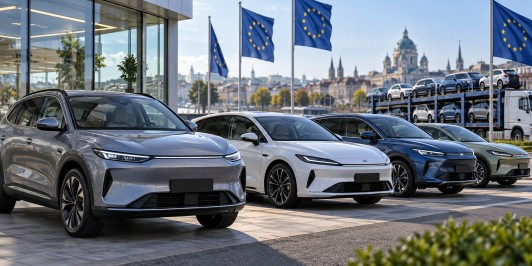
The surging influx of Chinese-made hybrid cars into the European Union is intensifying competitive pressure on local automakers, with Chinese brands rapidly capturing market share. As hybrid vehicles become increasingly predominant, accounting for nearly 37% of the European car market, the EU is grappling with how to protect its automotive industry from this burgeoning competition.
Sales figures underscore the dramatic rise of Chinese hybrids within the EU. In the first seven months of 2026, sales of fully hybrid vehicles from China skyrocketed to 160,662 units from a mere 659 in 2022. Similarly, Chinese plug-in hybrid vehicle sales jumped to 217,764 from 56,706 over the same period. This expansion coincides with the EU’s 2024 move to impose anti-subsidy tariffs on Chinese electric vehicles, which did not extend to hybrids.
In response to these developments, the European Commission has urged China to self-regulate its hybrid vehicle exports to the EU. Should negotiations fail to yield a voluntary agreement, the EU may implement safeguard measures, potentially including quotas, to shield its market.
Chinese automotive brands, such as BYD, Chery, and Leapmotor, are spearheading this market invasion, with BYD alone selling approximately 177,000 vehicles in the EU. Geely, the largest Chinese automotive group in Europe, sold around 205,000 vehicles in the first eight months of 2026. Despite these numbers, European manufacturers still hold the largest overall market share.
The increase in Chinese vehicle imports occurs as the EU strives to address a growing trade imbalance with China, posing a strategic challenge as it seeks to maintain the competitiveness of its own automotive sector. With fully electric vehicles making up just over 21% of the market, the EU’s regulatory framework and strategic responses will be crucial in shaping the future landscape of the automotive industry in Europe.