
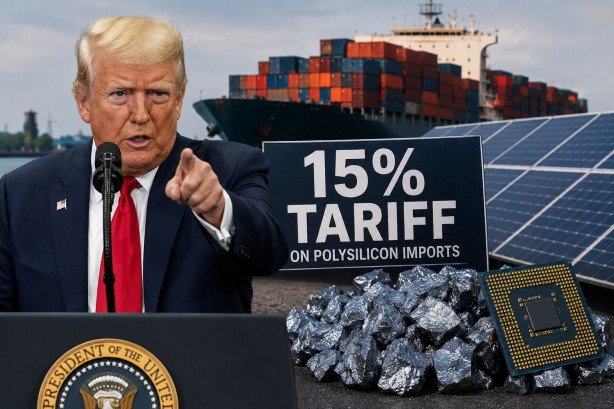
In a strategic move to bolster domestic manufacturing, US President Donald Trump has imposed a 15% tariff on imported goods made with polysilicon, a crucial component in the production of semiconductors and solar panels. The tariff, scheduled to be implemented on December 4, is part of a broader strategy to reduce dependence on Chinese imports. Polysilicon, known for its ultra-pure form of silicon, is essential in creating semiconductors used in artificial intelligence systems and data centers, as well as in solar cells and panels. Currently, China dominates the global production of this material.
The newly announced measures include setting minimum import prices at $21 per kilogram for polysilicon, $100 per kilogram for polysilicon ingots and wafers, and $0.22 per watt for solar cells. Solar modules and panels will also have a minimum import price of $0.38 per watt. These actions are designed to enhance the commercial feasibility of domestic polysilicon manufacturing and to fortify critical supply chains that are deemed vital for both economic and national security purposes.
China has responded critically to this decision, accusing the United States of exploiting national security concerns as a pretext to limit Chinese business operations. Chinese officials have warned that such protectionist measures could potentially disrupt trade relations between the two nations. Despite these tensions, the US administration remains focused on strengthening its polysilicon industry, which currently includes significant production facilities managed by Hemlock Semiconductor in Michigan and Wacker Chemie in Tennessee.
Moreover, the policy allows for the introduction of incentives aimed at encouraging investment in domestic polysilicon and related manufacturing facilities. These initiatives are part of a broader effort to secure vital supply chains and promote economic resilience. This tariff decision comes amidst China’s continued robust export growth, particularly in electronics, artificial intelligence-related products, and other high-value manufacturing sectors. The US move signals a strategic pivot towards reinforcing its manufacturing base while addressing global trade dynamics.