
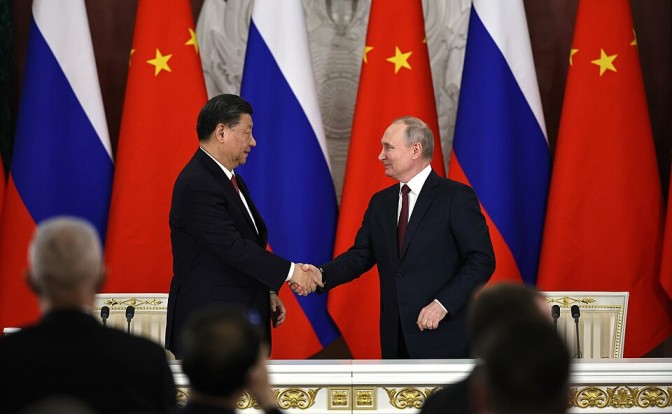
In a significant diplomatic development, Chinese President Xi Jinping and Russian President Vladimir Putin have agreed to extend the China-Russia Treaty of Good-Neighborliness and Friendly Cooperation. This decision underscores the commitment of both nations to bolster political mutual trust, strategic coordination, and practical cooperation amid global instability. The agreement was reached during a meeting at Beijing’s Great Hall of the People, marking the conclusion of Putin’s two-day visit to China. The leaders also signed a joint statement to enhance their comprehensive strategic coordination and witnessed the signing of 20 cooperation documents covering the economy, trade, education, and science and technology.
This year, China and Russia celebrate the 30th anniversary of their strategic partnership, with bilateral ties reaching unprecedented levels. President Xi highlighted that the alliance sets a benchmark for major-country relations, emphasizing that the two nations have consistently adhered to principles of non-alliance, non-confrontation, and not targeting any third party. The leaders issued a joint statement advocating for a multipolar world and equitable international relations, while also signing agreements across various sectors. The visit marked Putin’s 25th trip to China since 2000, illustrating the depth of their diplomatic ties.
Trade between China and Russia has flourished, with bilateral trade exceeding $200 billion annually for three consecutive years. In the first four months of 2026 alone, trade increased by nearly 20 percent. President Xi called for continued alignment of China’s 15th Five-Year Plan with Russia’s development strategy through 2030, aiming to upgrade cooperation to fuel both nations’ development. On global governance, Xi stressed the importance of adhering to international law and opposing unilateralism and hegemonism, advocating for a more just global governance system.
President Putin expressed confidence in the future of China-Russia relations, describing them as self-sufficient and unaffected by the current international climate. He emphasized the importance of deepening partnerships, strengthening people-to-people bonds, and contributing to mutual development. The leaders agreed to maintain their commitment to international law, the UN Charter, and cooperation within international structures like the Shanghai Cooperation Organization and BRICS.
Amid discussions on regional and global issues, Xi urged for an end to hostilities in the Middle East to stabilize energy supplies and international trade. Both nations announced visa-free travel extensions, fostering greater people-to-people exchanges. The visit concluded with a welcoming banquet for Putin, symbolizing the enduring friendship between the two nations. As both countries look to the future, they remain committed to expanding cooperation in trade, energy, transportation, and innovation, while strengthening cultural and educational exchanges.